So I arrived at SLA this morning and although the "official" conversations have yet to begin, one of the most powerful experiences for me so far is to be able to engage in conversations...actual conversations...longer than 14o character conversations with the folks who I have been reading and interacting with since next. I have finally gotten the opportunity to sit face to face, over dinner with folks whose minds I know very well, but whose faces I know only as tiny icons. What is most exciting to me...is that tomorrow and Sunday, I will have the opportunity to talk in depth about some really deep issues AND have time to reflect on these ideas...perhaps change is possible... if it is, these are surely the folks that are going to make it happen
Friday, January 25, 2008


Sunday, January 20, 2008
The Greatest Things I've ever learned....
...I've learned from my network.
I am constantly amazed and impressed with how collaborative the folks with whom I have connected with are. Earlier this month I watched as a 15 year old persevered in setting up his own "broadcast of the New Hampshire Primary Election. While the first 14 minutes are him getting the sound set up just right, I was so impressed not only with the quality of the broadcast but the self directed-ness, and the perseverence...here it was 9:00 at night and a student was, with his peers, creating a learning environment...outside of school....and this is why these tools pique my interest so much. I have had some ideas rolling around in my head since I saw that "broadcast", so I was determined to learn how to do this myself. Although he had a set of directions on his blog, I was having difficulty getting the sound to work myself, so I was even more impressed (and GRATEFUL) that he was willing to spend time helping me set it up myself. Students teaching teachers,outside beyond the walls of the school outside of the 8-3 day...
Needless to say, it was not quite as easy as his directions made it appear. He spent quite a bit of time helping me to craft the skill of ustreaming a skype call...I wanted to do more...I wanted to add the element of desktop sharing...skype +yugma + ustream....was it possible?
As I stated in my last post, I learn by doing--so when Chris Harbeck sent out a twitter wondering if there was a way to record a yugma screen sharing session...I thought it would be a great opportunity to test out these tools together. Sunday afternoon, outside of the school week, continued opportunities for learning...
Since one of my goals was to create and archive of my learning...I couldn't let this opportunity go without writing about it (besides, I promised Chris some good written instructions;-) so here is myremedial "digital immigrant" version of directions from my teacher...digital native Arthus.
HOW TO SKYPE USTREAM
Sorry folks these directions are for a mac :-)
STEP 1:
GET THE STUFF YOU NEED...
There are several applications I downloaded for this demo
LineIn
LineIn is an application for OS X to enable the soft playthru of audio from input devices. In simpler terms, you can use LineIn to play sound through a microphone or any other device plugged in to your Sound In port.
SoundFlower
Soundflower is a MacOS X system extension that allows an application to pass audio to an other application. I used the 2 channel simple version apparently there is a more complex one that allows you to pass to multiple applications....not ready to go there yet ;-)
When you install soundflower it is important to remember to drag SoundFlowerBed into your applications directory. That is what is used later.
CamTwist
Since 90% of the time my learning happens at home in my pajamas;-) I LOVE this application, all I have to do is open in and I can cast what ever I want, a picture, slideshow, desktop...you can add special effects to video chats.
While you are at it...you should get a yugma account. You can download a plugin which allows you to invite contacts via skype, but I didn't use that as you lose the ability to have a chat in yugma...
If you are planning on ustreaming...you will need to create an account (and channel) there as well.
NOW, restart your computer as prompted and get ready to go....
SET YOUR PREFERENCES
Before you can start a call you need to set up some preferences....
SET MAC SOUND PREFERENCES
THIS MUST BE DONE LAST and probably best to test while in a skype call
YUGMA: http://yugma.com if you have an account, you can start a session. This will give you a session # which you can use to invite others to share desktops
START USTREAM: SET PREFS THERE TOO...
When you go to broadcast you need to be sure to set your audio to sound flower (2ch) as well
WHY DO ALL THIS....?
Well...take a listen as Chris Harbeck shares some of his thoughts about using these tools to push the limits on a partnership he has with a class in Alabama...think about how powerful it will be for kids half way across a continent to be able to work through problems together...in the same space and time and have an archive of their work on which they can reflect. I have been spending a lot of time thinking through some ways this can be used to connect classes...
And my motives... I am planning on using this method to broadcast my session "The Connected Classroom" at PETE&C
I will be talking about web2.0 tools and how they can impact students...but would really like to SHOW the folks in my PA audience using Yugma what folks around the world are doing...Please let me know if you are interested in sharing through yugma with my audience some of the things you are doing in your classrooms:
Are you doing great things with...
I am constantly amazed and impressed with how collaborative the folks with whom I have connected with are. Earlier this month I watched as a 15 year old persevered in setting up his own "broadcast of the New Hampshire Primary Election. While the first 14 minutes are him getting the sound set up just right, I was so impressed not only with the quality of the broadcast but the self directed-ness, and the perseverence...here it was 9:00 at night and a student was, with his peers, creating a learning environment...outside of school....and this is why these tools pique my interest so much. I have had some ideas rolling around in my head since I saw that "broadcast", so I was determined to learn how to do this myself. Although he had a set of directions on his blog, I was having difficulty getting the sound to work myself, so I was even more impressed (and GRATEFUL) that he was willing to spend time helping me set it up myself. Students teaching teachers,
Needless to say, it was not quite as easy as his directions made it appear. He spent quite a bit of time helping me to craft the skill of ustreaming a skype call...I wanted to do more...I wanted to add the element of desktop sharing...skype +yugma + ustream....was it possible?
As I stated in my last post, I learn by doing--so when Chris Harbeck sent out a twitter wondering if there was a way to record a yugma screen sharing session...I thought it would be a great opportunity to test out these tools together. Sunday afternoon, outside of the school week, continued opportunities for learning...
Since one of my goals was to create and archive of my learning...I couldn't let this opportunity go without writing about it (besides, I promised Chris some good written instructions;-) so here is my
HOW TO SKYPE USTREAM
Sorry folks these directions are for a mac :-)
STEP 1:
GET THE STUFF YOU NEED...
There are several applications I downloaded for this demo
LineIn
LineIn is an application for OS X to enable the soft playthru of audio from input devices. In simpler terms, you can use LineIn to play sound through a microphone or any other device plugged in to your Sound In port.
SoundFlower
Soundflower is a MacOS X system extension that allows an application to pass audio to an other application. I used the 2 channel simple version apparently there is a more complex one that allows you to pass to multiple applications....not ready to go there yet ;-)
When you install soundflower it is important to remember to drag SoundFlowerBed
 into your applications directory. That is what is used later.
CamTwist
Since 90% of the time my learning happens at home in my pajamas;-) I LOVE this application, all I have to do is open in and I can cast what ever I want, a picture, slideshow, desktop...you can add special effects to video chats.
While you are at it...you should get a yugma account. You can download a plugin which allows you to invite contacts via skype, but I didn't use that as you lose the ability to have a chat in yugma...
If you are planning on ustreaming...you will need to create an account (and channel) there as well.
NOW, restart your computer as prompted and get ready to go....
SET YOUR PREFERENCES
Before you can start a call you need to set up some preferences....
SET MAC SOUND PREFERENCES
- Open system preferences and then sound preferences.
- Under the output tab, select Soundflower (2 ch).
- Under the input tab, select Internal microphone: built-in
- Close system prefs
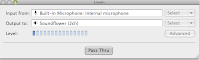
- Launch LineIn (Applications > LineIn.app).
- Set the Input to: From to Built-in Microphone: internal microphone (or whatever your input device is)
- Set the Output to: as Soundflower (2ch).
- Click: Pass Thru & then hide LineIn.

- open skype preferences
- Click on audio
- Set audio output to: soundflower(2ch)
- Set audio input to: Built in microphone: Internal microphone (or whatever mic you are using)
THIS MUST BE DONE LAST and probably best to test while in a skype call

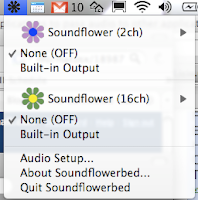
- Launch Soundflowerbed (Applications > Soundflowerbed.app) - it was on the Soundflower disk.
- A flower icon will appear in your menu bar. Click it and a menu will appear.
- Under Soundflower (2ch) switch from NONE (like in the image) to Built-in Output. (Or whatever your chosen speaker device is)
- you may need to click it off and then back on again if you can't hear anything (this was the trickiest part of the set up I think)
YUGMA: http://yugma.com if you have an account, you can start a session. This will give you a session # which you can use to invite others to share desktops
START USTREAM: SET PREFS THERE TOO...
When you go to broadcast you need to be sure to set your audio to sound flower (2ch) as well
WHY DO ALL THIS....?
Well...take a listen as Chris Harbeck shares some of his thoughts about using these tools to push the limits on a partnership he has with a class in Alabama...think about how powerful it will be for kids half way across a continent to be able to work through problems together...in the same space and time and have an archive of their work on which they can reflect. I have been spending a lot of time thinking through some ways this can be used to connect classes...
And my motives... I am planning on using this method to broadcast my session "The Connected Classroom" at PETE&C
I will be talking about web2.0 tools and how they can impact students...but would really like to SHOW the folks in my PA audience using Yugma what folks around the world are doing...Please let me know if you are interested in sharing through yugma with my audience some of the things you are doing in your classrooms:
Are you doing great things with...
- wikis
- blogs
- skype
- yugma
- voicethread
- gabcast
Thursday, January 17, 2008
Stuck in a rut...
So it has been a LONG time since I last posted...
Am not sure HOW I got in this rut, but I know that it is one that I REALLY need to get out of...
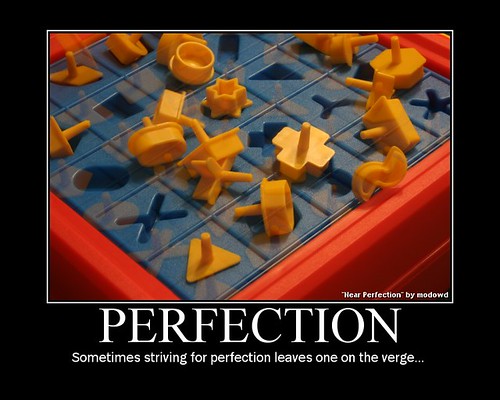
Today, after reaching the peak of my frustration level with the new network settings in my district I decided I was going to sit, relax, eat my lunch and do some blog reading...and this post by Vicki Davis Stood out for me...It was titled: Why I blog and Perils of Perfection and several of Vicki's comments really resonated with me...
What I think is the greatest challenge I have right now is not how much I fall short (and believe me I feel sometimes like I do fall quite short) but how much further behind others are. If I am going to be a model for others to learn from then I feel like I have to be on the cutting edge...I am constantly trying new things...but not taking the time to reflect....I have tried starting a journal for my exercise to improve my healthy habits..Folks say to me...3 kids, full-time job, I don't know how you do it (and sometimes I don't either) but what I do know is that taking the time to reflect WILL make me a better person both personally and professionally.
SO I am going to do as Vicki did...and examine the reasons that I DO blog...
Am not sure HOW I got in this rut, but I know that it is one that I REALLY need to get out of...
Today, after reaching the peak of my frustration level with the new network settings in my district I decided I was going to sit, relax, eat my lunch and do some blog reading...and this post by Vicki Davis Stood out for me...It was titled: Why I blog and Perils of Perfection and several of Vicki's comments really resonated with me...
I must admit that I've been suffering from a bit of perfection paralysis in the past week. I see so many things to write and as I've read several books on good technical writing over break, I see so much more that I need to be. I fall so short of things. V. Davis
What I think is the greatest challenge I have right now is not how much I fall short (and believe me I feel sometimes like I do fall quite short) but how much further behind others are. If I am going to be a model for others to learn from then I feel like I have to be on the cutting edge...I am constantly trying new things...but not taking the time to reflect....I have tried starting a journal for my exercise to improve my healthy habits..Folks say to me...3 kids, full-time job, I don't know how you do it (and sometimes I don't either) but what I do know is that taking the time to reflect WILL make me a better person both personally and professionally.
The other tough thing is that my life is so busy that I'm never "in the know" on "what is happening" in the blogosphere. I don't have the time to check twitter but probably once a day. I check my reader quickly several times a week and I talk on Wow2, however, as I have spent most of my life "out," I remain "out." V. DavisThere are days where I walk through the doors of my school and don't get to my office to put my bag down until almost lunch time. I am constantly running from place to place putting out fires, wondering if I am challenging my teachers enough or pushing them too far out of their comfort zones. I LEARN so much every day from my professional learning network and yet to sit and reflect on it all... is the most challenging thing for me right now. I understand the power of reflection...but I have felt lately a bit like I am screaming into the echo chamber and not I am not even hearing the reply of my own voice echoing back...
SO I am going to do as Vicki did...and examine the reasons that I DO blog...
- So that I can keep learning: Reflection is how I process information...and processing = learning
- To keep a running record of my learning: I can't tell you the number of times I have had a great learning experience and because I didn't reflect, it is difficult to replicate. I need to take time to really LEARN new things before I can apply them in my district. Hopefully reconnecting with my blog will help me to do this.
- Make connections: I can't tell you the number of folks with whom I have connected through blogs & commenting... and to build on that my final reason...
- To be an ACTIVE participant in the conversation.
Blogged with Flock
Friday, December 07, 2007
Students Speak are you listening?
Students from around the world have gotten together and are speaking out with their new network Students2.0. The Students 2.0 blog will feature content written by both staff writers and guest contributors. From Hawaii and Washington, from St. Louis and Chicago, from Vermont, New York, Scotland, Korea, and other points on the globe, these writings will be united in one central aspect: quality student writing, full-voiced and engaging, about education.
Why are they doing this...?
I think it best to use their own words...
For decades, students have been put in classrooms, sat down at desks, and told how to learn and what to learn. For a time when students were expected to become widgets for the vast machine of industry, this model of education was highly effective. However, we are now entering a new age: an age where thinking is more important than knowing, where the thought trumps the fact. Borders are melting away; project teams collaborate across the globe and intelligence is being continually redefined. The world’s information is at our fingertips and anybody can publish their thoughts for virtually no cost.
Everywhere, we see changes: in how business operates, in how people interact and success is accomplished. That is, we see changes everywhere besides the closed bars of education. The system continues to “stay the course” upon a falling ship. Yet, the widgets within the machine are no longer content to grind away. Ideas are popping up everywhere, across the globe. Students are continually redefining their own lives and how they want to learn and interact.
Adults and teachers talk about education and students, but rarely invite students into these discussions. Fortunately, this blog plans to change that by offering an authentic student voice upon education. This is not a gimmick, there's no puppet master: we're intent upon confronting the issues of modern education, never backing down from a challenge. Students 2.0 is challenge for leaders and teachers alike: are you willing to listen to students
Pretty powerful considering it was these students drive alone that developed this idea. Do you know a student like this in your class...or 2 or 3...? How do you engage a student who is so driven? I know I will be tuning in to see what they have to say!
Students 2.0 Launch Teaser from Sean on Vimeo.
Wednesday, December 05, 2007
Cooking with Jeff and learning Chinese from Shanghai
Wednesdays have gone from "hump day" to my favorite day of the week...
WHY? Cooking with Jeff of course
 Each Wednesday evening in Shanghai, Jeff Utecht's wife has her Chinese lesson while Jeff cooks dinner. Through twitter, Jeff changes his avatar to a chef and folks from around the world follow along as Jeff outlines the steps to his evening meal. Mind you, I am following this at about 5 am EST as I am getting ready to start MY Wednesday...and when the meal sounds good, I stop at the store, pick up the ingredients and "cook along". This morning Paul Harrington actually suggested Jeff live stream the preparation. hmmmm.....live streaming a "cooking show" from China.....
Sound silly? Sure it does. Until you stop and think about the implications. How cool would it be to look into the kitchen of someone in China as they prepare their evening meal. To have that lesson recorded so that as I am preparing the same meal, I have something to follow. Or better yet...let Jeff continue to "tweet" his prep....I'd love to "sit in" on his wife's Chinese lesson via ustream.tv or some other application. To be able to enjoy the accent, the culture of a learning experience from another part of the world.
And speaking of how things are different around the world this conversation was floating around my network today...
Lots of school closures today in America! Let it snow let it snow let it snow!
Why has your school closed? My list: snow, earthquake, typhoon, terrorism, King died, water pipe breakage...what's yours?
Your list is more interesting than mine. Snow, power outage, gas main break.
chemical spill in the science lab...that's a new one. :)
Yes, my eyes have really been open to the way things are around the world and while I have physically visited very few places outside of the US, my network has REALLY caused me to think about the world, world issues, and the future in different ways.
Now, If we can start to do that for our kids...
Powered by ScribeFire.
 Each Wednesday evening in Shanghai, Jeff Utecht's wife has her Chinese lesson while Jeff cooks dinner. Through twitter, Jeff changes his avatar to a chef and folks from around the world follow along as Jeff outlines the steps to his evening meal. Mind you, I am following this at about 5 am EST as I am getting ready to start MY Wednesday...and when the meal sounds good, I stop at the store, pick up the ingredients and "cook along". This morning Paul Harrington actually suggested Jeff live stream the preparation. hmmmm.....live streaming a "cooking show" from China.....
Sound silly? Sure it does. Until you stop and think about the implications. How cool would it be to look into the kitchen of someone in China as they prepare their evening meal. To have that lesson recorded so that as I am preparing the same meal, I have something to follow. Or better yet...let Jeff continue to "tweet" his prep....I'd love to "sit in" on his wife's Chinese lesson via ustream.tv or some other application. To be able to enjoy the accent, the culture of a learning experience from another part of the world.
And speaking of how things are different around the world this conversation was floating around my network today...
Lots of school closures today in America! Let it snow let it snow let it snow!
Why has your school closed? My list: snow, earthquake, typhoon, terrorism, King died, water pipe breakage...what's yours?
Your list is more interesting than mine. Snow, power outage, gas main break.
chemical spill in the science lab...that's a new one. :)
Yes, my eyes have really been open to the way things are around the world and while I have physically visited very few places outside of the US, my network has REALLY caused me to think about the world, world issues, and the future in different ways.
Now, If we can start to do that for our kids...
Powered by ScribeFire.
Wednesday, November 28, 2007
The Importance of Global Citizenship
British teacher Gillian Gibbons stands accused of
insulting Islam's Prophet after allowing her pupils in Sudan to name a
teddy bear Muhammad. What are the rules on using the name?
I was intrigued by this article I came across on Twitter recently...to me it really spoke to the importance of teaching our kids through a lens of Global Citzenship and an understanding of others. It is why projects like Life 'Round Here, 1001 Flat World Tales, and The 2007 Flat Classroom Project are essential. It is why we should be encouraging kids to blog & read others' blogs. I know that the edtech world is talking about the importance of digital citizenship, but we need to begin to reach further...
The article ends...
"People are very forgiving of foreigners, particularly
Europeans. Nobody would think she was trying to offend them - they
would just think she was ignorant."
Is it acceptable anymore to even use ignorance as an excuse? It is a flat world. We must educate ourselves and our students. That in my opinion is the only crime committed, failing to understand cultural difference. Thoughts?
insulting Islam's Prophet after allowing her pupils in Sudan to name a
teddy bear Muhammad. What are the rules on using the name?
I was intrigued by this article I came across on Twitter recently...to me it really spoke to the importance of teaching our kids through a lens of Global Citzenship and an understanding of others. It is why projects like Life 'Round Here, 1001 Flat World Tales, and The 2007 Flat Classroom Project are essential. It is why we should be encouraging kids to blog & read others' blogs. I know that the edtech world is talking about the importance of digital citizenship, but we need to begin to reach further...
The article ends...
"People are very forgiving of foreigners, particularly
Europeans. Nobody would think she was trying to offend them - they
would just think she was ignorant."
Is it acceptable anymore to even use ignorance as an excuse? It is a flat world. We must educate ourselves and our students. That in my opinion is the only crime committed, failing to understand cultural difference. Thoughts?
Powered by ScribeFire.
Thursday, November 08, 2007
Lost in Translation
Lance Rougeux recently delivered the Keynote at TRETC (Three Rivers Ed Tech Conference) in Western PA. His message....today all students are bilingual.
His presentation had tons of cool data: Alexia.com's top site ranking for 2007...Guess which site is in the top 10 up 6 spots? Facebook...Great sites for connecting to kids' brains which are "plugged in" 6 1/2 hours a day (how long do they spend in school...hmmm) voicethread, moonk, and mosaickr were 3 that stood out to me....and he gave us as educators a new job....learn this 2nd language!
wnt 2 git yor students 2 relate 2 wot iz hapNn n yor claS @ skul? Try DIS..
http://www.transl8it.com/
Read Lauren Myracle Books, blogs, investigate Web2.0 tools, and participate in free PD offered by Discovery Educator Network
His whole presentation is available on the DEN Blog I know I will use some of it as I try to move folks forward
His presentation had tons of cool data: Alexia.com's top site ranking for 2007...Guess which site is in the top 10 up 6 spots? Facebook...Great sites for connecting to kids' brains which are "plugged in" 6 1/2 hours a day (how long do they spend in school...hmmm) voicethread, moonk, and mosaickr were 3 that stood out to me....and he gave us as educators a new job....learn this 2nd language!
wnt 2 git yor students 2 relate 2 wot iz hapNn n yor claS @ skul? Try DIS..
http://www.transl8it.com/
Read Lauren Myracle Books, blogs, investigate Web2.0 tools, and participate in free PD offered by Discovery Educator Network
His whole presentation is available on the DEN Blog I know I will use some of it as I try to move folks forward
Monday, October 22, 2007
Reflections on One Year
Today is my birthday...I am one year closer to forty... (too close if you ask me)
I must say...this has been one of the most interesting birthdays I have had to date!
Yesterday afternoon (4pm EDT) I was skyped a happy birthday message from Jo McLeay from Australia (where it was already my bday) and by 8:00 am this morning I had received Happy Birthday wishes via:
So on my birthday, I started to reflect on this past year. Most of the folks who took time out of their day to wish me a happy birthday I didn't know 1 year ago...Many of them I have never really met face to face.
1 year ago, I celebrated my birthday on a hayride with my family...and then the learning began
In the meantime, THANKS for all of the birthday wishes, and thanks for continuing to be a part of my learning network--I look forward to many more years of learning with all of you
I must say...this has been one of the most interesting birthdays I have had to date!
Yesterday afternoon (4pm EDT) I was skyped a happy birthday message from Jo McLeay from Australia (where it was already my bday) and by 8:00 am this morning I had received Happy Birthday wishes via:
email (in several accounts), a Hallmark ecard, and twitter. Several folks popped in via my skype. I received notes on my wall, a gift and a message in my Facebook...F2F my kids & husband got up early to sing, I was greeted by kids in the hall at school (there are 2 seniors--twins with whom I share a birthday...word gets around), and my colleagues left a gift and card on my desk. I received messages on my home phone, my cell phone, my office phone...
So on my birthday, I started to reflect on this past year. Most of the folks who took time out of their day to wish me a happy birthday I didn't know 1 year ago...Many of them I have never really met face to face.
1 year ago, I celebrated my birthday on a hayride with my family...and then the learning began
- 3 days later I was offered my current job (tech integration coach for Classrooms for the Future) AND my daughter was born
- 1 month later I used my mac for the first time
- I attended bootcamp for Classrooms for the Future and made a few connections
- I created my Connected Classroom video and presented at PETE & C where even before the video was unveiled, I made a few more connections.
- In June attended edubloggercon where I reconnected with a few folks and connected face to face with a few more.
- In July was on staff at the Keystone Summit where connectivity was a sort of a theme
- In the fall CFF Bootcamp rolled around again...and the network I had grown helped make the presentation I did on del.icio.us pretty powerful.
In the meantime, THANKS for all of the birthday wishes, and thanks for continuing to be a part of my learning network--I look forward to many more years of learning with all of you
Thursday, October 11, 2007
We have a lot to learn...
I don't even know where to begin to talk about the online learning explosion and information overload I have encountered lately, between k-12 online keynote and fireside chat, WOW2 which topped 60 learners, and ustream....my infrequent posts
are telling me I need to SLOW DOWN and start reflecting to complete the learning process. And boy do we have a lot to learn...
We have a lot to learn about the tools
I wrote earlier about my experience with google presentations. Having all of those folks "show up" for my session was a very powerful model of the tools, but for me it was missing one critical element, the ability for folks who are not there in the room to hear the audio was a real set back. I wanted to LEARN A WAY to add audio to google presentations....but how?
I decided to try google presos another time, with skype. I was invited to "present" a session on Google tools to a class who was at a distance. I could "call into" the class using skype and then use my goole presentation to talk about google tools. Solves PART of the problem, now folks outside the physical room could hear, but only a limited group...those on the skype call. I had directions to the class wiki, but this still did not meeting the objective of bringing folks "in" to the presentation. So right before I "skyped" into Bucks IU for my presentation I had a brain fire...Ustream has been a real hot tool lately--why not use THAT for the audio for afar while using SKYPE to connect with the class I was teaching...really quickly I threw together a channel and twittered it out and lo and behold...I had a few viewers who could either watch me in my office OR use the audio from ustream to hear the content and they could follow along with the "class" in the Google Presentation. I wasn't running ustream "chat" but via skype chat a few folks told me it would be great if they could hear the content....My mind started to think about the possibilities and the roadblocks of the tool....how else could it be used?
We have a lot to learn from / with others
So I spent some time popping in on ustream channels...it is kind of like dvr in that if you don't catch the live version, you can catch the recording...So I popped in on Will Richardson from time to time...he proved that ustream could really easily be done wirelessly. Darren Draper used a dv camera to shoot his screen. CamTwist was demonstrated as a way to run multiple stream....I REALLY wanted to get a chance to test that skype call again....so when I saw over twitter a ustream skype test, I just had to jump in. The room was packed, the video was choppy, the audio was echoing ....Vicki Davis and I were DYING to figure out if we really DID need all of the software solutions suggested, it seemed to work fine when I did it in my class so I asked her to hop over to my channel to test, http://ustream.tv/channel/the-connected-classroom. The next thing you know I was in a room with 16 viewers and we did IT....we ran multiple skype callers on a ustream video. I wish I had installed and played with my camtwist prior as the "show" was visually not all that appealing....I wasn't planning to broadcast but I had a network of folks willing to help....and now I think I have all of the pieces....but the reality of it is, it is not about LEARNING THE TOOLS...it is is about what these tools can do in our schools to help kids to engage in the learning process....Isn't the most important learning the learning we do when we listen to the kids....
We have a lot to learn from / with OUR STUDENTS
In David Warlick's keynote for k12 online conference, he talked about the kids being different, about how they are so connected outside of school and they come to school and their connections are cut off. He talked about his son and showed an example, he talked ABOUT them, but the one thing I think was missing...was talking TO the kids...
UStream had several folks talking to kids...
Web-logg-ed TV Will talked to some kids about Gaming. On Practical-theory-TV Chris Lehmann talked to his kids about how they see SLA and what makes their experience there different than a more traditional High School. I really like how his reflection of this experience was part of his learning process...
The thing that is coming through--very powerfully--is the message that for our kids, the technology comes second. And just by happenstance, on my OWN ustream channel a VERY powerful conversation with a 14 year old web programmer from VT. Ardus had been doing web-design consulting since he was 12, and Vicki...who is an amazing host asked him...how do you envision schools? I asked if school was engaging to him? and we talked about what it would take for that to occur. Unfortunately here at my school I can't get enough bandwidth to stream and relisten, but I will post the audio remix later...but his message was POWERFUL--and really I had an epiphany when I stopped to really reflect on it...Ardus said that in school, (and I am paraphrasing from my memory of the conversation) there isn't a whole lot that the teacher is telling him, that he can't google to find....more important the teachers should be teaching kids how to think and solve problems. He talked about a teacher that had good pedagological practices without the computers. We need to remember this. Right now, we are getting tools to change practices....there are some practices that we SHOULDN'T CHANGE just because we have the tools! Yes we need learn about the tools, but it is not about the tools exclusively. Chris Lehman said...
As we think about 21st Century tools and reforming education, we need to remember that we use the tools to leverage the relationships, to extend the relationships, to push a progressive, inquiry-driven, understanding-driven, project-based way of teaching and learning, but without the pedagogy, the tools are nowhere near as powerful.
Yes, we are content experts and we have lot to share but as Arthus said, the most important thing we can do is learn how to learn...Please, read this boy's blog it is so interesting in this echo chamber to hear the voices of the students...
Yes, we have a lot to learn about our kids...we have a lot to learn FROM our kids If you ask them, I am sure they will tell you... They may not know the tools as Arthus does, but they know that they have to start to learn differently, isn't it time we start to listen?
are telling me I need to SLOW DOWN and start reflecting to complete the learning process. And boy do we have a lot to learn...
We have a lot to learn about the tools
I wrote earlier about my experience with google presentations. Having all of those folks "show up" for my session was a very powerful model of the tools, but for me it was missing one critical element, the ability for folks who are not there in the room to hear the audio was a real set back. I wanted to LEARN A WAY to add audio to google presentations....but how?
I decided to try google presos another time, with skype. I was invited to "present" a session on Google tools to a class who was at a distance. I could "call into" the class using skype and then use my goole presentation to talk about google tools. Solves PART of the problem, now folks outside the physical room could hear, but only a limited group...those on the skype call. I had directions to the class wiki, but this still did not meeting the objective of bringing folks "in" to the presentation. So right before I "skyped" into Bucks IU for my presentation I had a brain fire...Ustream has been a real hot tool lately--why not use THAT for the audio for afar while using SKYPE to connect with the class I was teaching...really quickly I threw together a channel and twittered it out and lo and behold...I had a few viewers who could either watch me in my office OR use the audio from ustream to hear the content and they could follow along with the "class" in the Google Presentation. I wasn't running ustream "chat" but via skype chat a few folks told me it would be great if they could hear the content....My mind started to think about the possibilities and the roadblocks of the tool....how else could it be used?
We have a lot to learn from / with others
So I spent some time popping in on ustream channels...it is kind of like dvr in that if you don't catch the live version, you can catch the recording...So I popped in on Will Richardson from time to time...he proved that ustream could really easily be done wirelessly. Darren Draper used a dv camera to shoot his screen. CamTwist was demonstrated as a way to run multiple stream....I REALLY wanted to get a chance to test that skype call again....so when I saw over twitter a ustream skype test, I just had to jump in. The room was packed, the video was choppy, the audio was echoing ....Vicki Davis and I were DYING to figure out if we really DID need all of the software solutions suggested, it seemed to work fine when I did it in my class so I asked her to hop over to my channel to test, http://ustream.tv/channel/the-connected-classroom. The next thing you know I was in a room with 16 viewers and we did IT....we ran multiple skype callers on a ustream video. I wish I had installed and played with my camtwist prior as the "show" was visually not all that appealing....I wasn't planning to broadcast but I had a network of folks willing to help....and now I think I have all of the pieces....but the reality of it is, it is not about LEARNING THE TOOLS...it is is about what these tools can do in our schools to help kids to engage in the learning process....Isn't the most important learning the learning we do when we listen to the kids....
We have a lot to learn from / with OUR STUDENTS
In David Warlick's keynote for k12 online conference, he talked about the kids being different, about how they are so connected outside of school and they come to school and their connections are cut off. He talked about his son and showed an example, he talked ABOUT them, but the one thing I think was missing...was talking TO the kids...
UStream had several folks talking to kids...
Web-logg-ed TV Will talked to some kids about Gaming. On Practical-theory-TV Chris Lehmann talked to his kids about how they see SLA and what makes their experience there different than a more traditional High School. I really like how his reflection of this experience was part of his learning process...
The thing that is coming through--very powerfully--is the message that for our kids, the technology comes second. And just by happenstance, on my OWN ustream channel a VERY powerful conversation with a 14 year old web programmer from VT. Ardus had been doing web-design consulting since he was 12, and Vicki...who is an amazing host asked him...how do you envision schools? I asked if school was engaging to him? and we talked about what it would take for that to occur. Unfortunately here at my school I can't get enough bandwidth to stream and relisten, but I will post the audio remix later...but his message was POWERFUL--and really I had an epiphany when I stopped to really reflect on it...Ardus said that in school, (and I am paraphrasing from my memory of the conversation) there isn't a whole lot that the teacher is telling him, that he can't google to find....more important the teachers should be teaching kids how to think and solve problems. He talked about a teacher that had good pedagological practices without the computers. We need to remember this. Right now, we are getting tools to change practices....there are some practices that we SHOULDN'T CHANGE just because we have the tools! Yes we need learn about the tools, but it is not about the tools exclusively. Chris Lehman said...
As we think about 21st Century tools and reforming education, we need to remember that we use the tools to leverage the relationships, to extend the relationships, to push a progressive, inquiry-driven, understanding-driven, project-based way of teaching and learning, but without the pedagogy, the tools are nowhere near as powerful.
Yes, we are content experts and we have lot to share but as Arthus said, the most important thing we can do is learn how to learn...Please, read this boy's blog it is so interesting in this echo chamber to hear the voices of the students...
Yes, we have a lot to learn about our kids...we have a lot to learn FROM our kids If you ask them, I am sure they will tell you... They may not know the tools as Arthus does, but they know that they have to start to learn differently, isn't it time we start to listen?
Powered by ScribeFire.
Tuesday, October 02, 2007
It should be easy...
This post has been sitting in my scribefire for a long time since I lost the original...Today Jen Wagner's post on watching out not to be a "tech snob" brought me back....
This summer while I was doing summer professional development, I caught a few questions about exporting bookmarks from explorer that I couldn't answer...so I put them out to my network "It should be easy..." Jim Gates quickly replied .. "Shouldn't be hard at all..." came in from a twitter direct message from Steve Hardagon.. and really they ARE RIGHT....it SHOULD be simple.
But it is NOT and I am really torn between blaming the structures that prevent innovations and wondering when folks need to take accountability for some of this leaning on their own.
I had the pleasure of having the opportunity to get to hear David Warlick speak at CFF bootcamp last week. He talked about some of the things that should be happening in school, that NEED to be happening in schools. He recognized that this is obviously a complex issue, as education should be. Its more than can be expressed in a single blog. He stated that a teacher's job is not simple — not any more. The world that we are preparing our children for is complex, dynamic, and it may never be the same again. But it is also intensely exciting —
..and learning about that world, should be just as exciting as that world really is.
In TechLearning Terry Freeman made some powerful statements about some things which we must regard as simply unacceptable. Karl Fisch went so far as to say....If a teacher today is not technologically literate - and is unwilling to make the effort to learn more - it's equivalent to a teacher 30 years ago who didn't know how to read and write. Now I think this is an unfair analogy in that the internet and technological tools have not been around nearly as long as written works, but the world SURE IS moving QUICK and I think that everyone has a certain amount of responsibility to keep up. David Warlick and Chris Lehmann both had great posts which have been rumbing around in my head as well..
All of this making me think....
When is it ok...
This summer while I was doing summer professional development, I caught a few questions about exporting bookmarks from explorer that I couldn't answer...so I put them out to my network "It should be easy..." Jim Gates quickly replied .. "Shouldn't be hard at all..." came in from a twitter direct message from Steve Hardagon.. and really they ARE RIGHT....it SHOULD be simple.
But it is NOT and I am really torn between blaming the structures that prevent innovations and wondering when folks need to take accountability for some of this leaning on their own.
I had the pleasure of having the opportunity to get to hear David Warlick speak at CFF bootcamp last week. He talked about some of the things that should be happening in school, that NEED to be happening in schools. He recognized that this is obviously a complex issue, as education should be. Its more than can be expressed in a single blog. He stated that a teacher's job is not simple — not any more. The world that we are preparing our children for is complex, dynamic, and it may never be the same again. But it is also intensely exciting —
..and learning about that world, should be just as exciting as that world really is.
In TechLearning Terry Freeman made some powerful statements about some things which we must regard as simply unacceptable. Karl Fisch went so far as to say....If a teacher today is not technologically literate - and is unwilling to make the effort to learn more - it's equivalent to a teacher 30 years ago who didn't know how to read and write. Now I think this is an unfair analogy in that the internet and technological tools have not been around nearly as long as written works, but the world SURE IS moving QUICK and I think that everyone has a certain amount of responsibility to keep up. David Warlick and Chris Lehmann both had great posts which have been rumbing around in my head as well..
All of this making me think....
When is it ok...
- Is it ok for a tech integration coach to not know what an RSS feed is?
- How can we support teachers to learn how to use these tools that they don't even know exist?
- Should we expect to always get professional emails that contain an appropriate subject line and signature?
- Should we still be helping people add attachments to an email?
- Why can astronauts blog from outer space, with elementary students but it is too difficult for classroom teachers?
- When do we stop and say it is unacceptable?
Learning Web2.0 in Bangkok and a Del.icio.us session in PA
I returned to my room at boot camp to prepare for my Del.icio.us session this past Thursday... I was still a little nervous to be using Google Presentation. I had experience learning it with Vicki Davis and crew when we created a virtual "How to" and had used it the week before but it was still very new to me. When I logged onto my computer to prepare, I saw a tweet that Kim Cofino was doing a Web2.o session in IBS. I was a bit late for the chat, but how cool to see folks from around the world participating in the chat window.
Close to 100 people...both in the room and beyond were ENGAGED...engaged in learning. Some were learning delicious, some were setting up an account, some were learning google presentation, some were sharing resources, but ALL were engaged. And we learned a lot of valuable things..even with some great scribes in the room (thanks Jim, Lori & Dianne) google presos REALLY are better with audio. We learned that we wished you could archive google chats so I could tell you all that we learned....
and it made me realize a few things too...It made me realize how grateful I am to have such a TREMENDOUS network who are always willing to share their knowledge with others and work on ways to share new tools.
Thanks to all of you for continuing to help me grow...keep on tweeting...so we can keep learning together
I mentioned in Kim's session that I was there to practice for my session in the am (mind you it WAS morning in Bangkok already.) and the folks in the room asked me to put a link up via twitter....so I did.
What happened over the course 2 hours was both mind blowing and flattering. It seemed like my entire blog roll popped in my 2 sessions. An amazing group of people coming to learn and try a new tool, but they provided and EXCELLENT example of a collaborative network in action. From the Southern Hemisphere Graham Wegner from Adelaide AU, Allannah K New Zealand, Carolyn Foote Stephanie Sandifer & John Pederson all popped in from TX, and Chris Harbeck from Manitoba Canada. Kim Cofino was now finishing her day in Bangkok Thailand where it was 8:22 pm Thurs and Chris Lehmann principal of Science Leadership academy in Phila PA stopped in to heckle. From IL, Vinnie Vrotny and David Jakes digital storytelling guru dropped by from which was great to point out after our AFI training. So did Darin Draper with whom I am taking a great Social Software class and Mark Wagner and Jennifer Wagner from WOW2 show on edtech talk PA Keystone Scott Snyder took time out of his day.... Chrissy from New Zealand (where it was now 2 am) shared a video from YouTube and Patrick Higgins dropped a link to his social bookmarking wiki In addition 50 people from my "actual session" were logged in..
Close to 100 people...both in the room and beyond were ENGAGED...engaged in learning. Some were learning delicious, some were setting up an account, some were learning google presentation, some were sharing resources, but ALL were engaged. And we learned a lot of valuable things..even with some great scribes in the room (thanks Jim, Lori & Dianne) google presos REALLY are better with audio. We learned that we wished you could archive google chats so I could tell you all that we learned....
and it made me realize a few things too...It made me realize how grateful I am to have such a TREMENDOUS network who are always willing to share their knowledge with others and work on ways to share new tools.
Thanks to all of you for continuing to help me grow...keep on tweeting...so we can keep learning together
Sunday, September 30, 2007
SLOW DOWN, you're in a school zone...
“It’s easy to drive fast in a Ferrari.”--- Graham Wegner
 Once they can get the teacher in their Ferrai and start to teach them the power it has, they are restricted by the school limits...
Many coaches returned to their schools from bootcamp only to find that their district has blocked many of the tools and resources that they learned that can help their teachers to start on the fast track. Many of the network administrators see only the danger, not the power of the tools. My advice, don't go to the network guys, go to the people who make the decisions about curriculum and instructional practices. Go to them with examples in other words, put THEM in your Ferrari and take THEM for a RIDE!!!
I continue to urge people get in the race...get behind the wheel of your Ferrari step on the gas, take it out on the road, and see what it really can do...as far as the school zones....
Thoughts?
Image uploaded with Skitch!
 I recently read a post by Graham Wegner which described that while voices like Kim Cofino, Jeff Utecht, Susan Sedro and Clay Burell have a lot to say about the power of embedding technology into teaching & learning experiences for their students. But as a realist...he sees that when the the ferrari is not there, all you have are teachers that are trying to make due with their hotted up Monaro....this analogy of racing on a track, really hit home for me and I'd like to take it one step further
What happens when GIVEN the Ferrari?
Through Classrooms For the Future we have been given the Ferrari of classrooms....sets of laptops, Interactive Whiteboards and LCD projector, digital still and video cameras, scanners, speakers.... and yet the teachers in these classrooms still have concerns.
Working with teachers who are comfortable with the car they've got
 Some folks are very comfortable driving their Toyota Camrys. They are comfortable with the way it drives, they know how the tools work, and they can make their Camray go as fast (or as slow) as they like. It is dependable and that is what makes it so easy to drive. Some folks are afraid of getting in that Ferrari and the risk that comes with driving fast.
I recently read a post by Graham Wegner which described that while voices like Kim Cofino, Jeff Utecht, Susan Sedro and Clay Burell have a lot to say about the power of embedding technology into teaching & learning experiences for their students. But as a realist...he sees that when the the ferrari is not there, all you have are teachers that are trying to make due with their hotted up Monaro....this analogy of racing on a track, really hit home for me and I'd like to take it one step furtherWhat happens when GIVEN the Ferrari?
Through Classrooms For the Future we have been given the Ferrari of classrooms....sets of laptops, Interactive Whiteboards and LCD projector, digital still and video cameras, scanners, speakers.... and yet the teachers in these classrooms still have concerns.
Working with teachers who are comfortable with the car they've got
 Some folks are very comfortable driving their Toyota Camrys. They are comfortable with the way it drives, they know how the tools work, and they can make their Camray go as fast (or as slow) as they like. It is dependable and that is what makes it so easy to drive. Some folks are afraid of getting in that Ferrari and the risk that comes with driving fast.Once they can get the teacher in their Ferrai and start to teach them the power it has, they are restricted by the school limits...
Many coaches returned to their schools from bootcamp only to find that their district has blocked many of the tools and resources that they learned that can help their teachers to start on the fast track. Many of the network administrators see only the danger, not the power of the tools. My advice, don't go to the network guys, go to the people who make the decisions about curriculum and instructional practices. Go to them with examples in other words, put THEM in your Ferrari and take THEM for a RIDE!!!
I continue to urge people get in the race...get behind the wheel of your Ferrari step on the gas, take it out on the road, and see what it really can do...as far as the school zones....
Thoughts?
Thursday, September 27, 2007
Keeping Teachers AFLOAT...
I must say that the CFF bootcamp this year was a very rewarding experience as it has given me the opportunity to reflect on my past year of learning, remember where I was 6 months ago, and think about the possibility for the coming year.
Having the opportunity to be a technology integration coach in a tremendous program like Classrooms for the Future and helping teachers to prepare their students can certainly be a challenge as evidenced by the final project created by the gentlemen in my county...thanks @kenrodoff for making this available. I am sure that many of us, even the most proficient user, at times, with all of the tools, and learning opportunities, feel overwhelmed...like they are drowning in a sea of information
The most powerful part of this initiative is the coach, the person who keeps folks afloat as reflected in the ladies's final project...
I encourage everyone to reflect on this role and how we have a responsibility as educators to continue to work together. Please add your voice, your thoughts to our voice thread!!!!
Thanks to my global network and all of the CFF Coaches who are helping me to grow as a teacher, to improve education for my kids....You are an AMAZING group...have a great year!!!!
Having the opportunity to be a technology integration coach in a tremendous program like Classrooms for the Future and helping teachers to prepare their students can certainly be a challenge as evidenced by the final project created by the gentlemen in my county...thanks @kenrodoff for making this available. I am sure that many of us, even the most proficient user, at times, with all of the tools, and learning opportunities, feel overwhelmed...like they are drowning in a sea of information
The most powerful part of this initiative is the coach, the person who keeps folks afloat as reflected in the ladies's final project...
I encourage everyone to reflect on this role and how we have a responsibility as educators to continue to work together. Please add your voice, your thoughts to our voice thread!!!!
Thanks to my global network and all of the CFF Coaches who are helping me to grow as a teacher, to improve education for my kids....You are an AMAZING group...have a great year!!!!
Wednesday, September 26, 2007
Progressive Education
How much have our schools REALY changed in the past 50 or 60 years....
and yet...
How much has our world changed...
I think about all of the tools for collaboration and conversation that weren't available even 9 months ago...
And how things will be different by the time NECC rolls around 9 months from now...
 I have spent the past week at a "boot camp" for PA educators who are working to help implement a state program so that districts can begin to help their students use 21st Century tools for learning. I know that there has been a LOT put out on platters....sometimes too much. But at least the conversations have begun... I am glad I am developing a network of folks who are thinking about these things, becoming agents for change....for the most important reasonsWhat are you doing, what new things have you learned, how can you act to make these changes happen in your world?
Monday, September 17, 2007
What have you bookmarked lately?
Keeping up with my world has been a little daunting these days, but I wanted to be sure to get a quick post out as I have been tagged...while I am not a big fan of these memes I kind of liked going to Lisa's site and seeing what she has been bookmarking and since I am doing a workshop on Del.icio.us later this week so I thought it would be a good way to prove the power of networks as well as find some other del.icio.us users to add to my network.
So here are the rules and here are my bookmarked sites...
1) Once you've been tagged, link your most recent bookmarked pages back to your blog
2) Name the tag that you have used so others can access the links easily in a blog post
3) At the end of your post, tag 6 people and list their names, linking to them.
4) Leave a comment on their blog, letting them know they've been tagged.
So what have I bookmarked on del.icio.us lately?
Kentucky Virtual Library has a neat how to do research page: I like the steps listed Plan, Search for Information, Take Notes, Use the Information, Report, and Evaluate and that each step models links for student use.
I also bookmarked this article from EdWeek about whether our Graduates are writing ready
I think the process of blogging in subject areas is fascinating and while I have read Dan Myer's Math blog for a while now, I came upon all of Chris Harbeck's Math blogs and wikis, boy is he doing neat things in middle school training kids to think about the Math Process.
Another cool blog project. Have students blog the story of Hamlet from the voice of the characters. The difference between Gertrude's and Hamlet's blogs from the theme of the skins to the voice of the writing is fun to see and I use this as an example all the time
With much of the "international travel" I have done lately with flashmeeting, I was looking for a timezone converter and really like this one.
So there you have it what I have bookmarked recently
I am going to call on some of my PA / del.icio.us network....
A. To help me out with my presentation at the CFF Bootcamp over the next 2 weeks
B. Cause you haven't shared anything recently with the tag for:hokie62798
Ken Rodoff
Kurt Paccio
Ken Pruitt
Chris Champion
Jim Gates
Even if you weren't tagged, feel free to leave me your most recent bookmarks here or better yet, tag them for:hokie62798 on del.icio.us
So here are the rules and here are my bookmarked sites...
1) Once you've been tagged, link your most recent bookmarked pages back to your blog
2) Name the tag that you have used so others can access the links easily in a blog post
3) At the end of your post, tag 6 people and list their names, linking to them.
4) Leave a comment on their blog, letting them know they've been tagged.
So what have I bookmarked on del.icio.us lately?
Kentucky Virtual Library has a neat how to do research page: I like the steps listed Plan, Search for Information, Take Notes, Use the Information, Report, and Evaluate and that each step models links for student use.
I also bookmarked this article from EdWeek about whether our Graduates are writing ready
I think the process of blogging in subject areas is fascinating and while I have read Dan Myer's Math blog for a while now, I came upon all of Chris Harbeck's Math blogs and wikis, boy is he doing neat things in middle school training kids to think about the Math Process.
Another cool blog project. Have students blog the story of Hamlet from the voice of the characters. The difference between Gertrude's and Hamlet's blogs from the theme of the skins to the voice of the writing is fun to see and I use this as an example all the time
With much of the "international travel" I have done lately with flashmeeting, I was looking for a timezone converter and really like this one.
So there you have it what I have bookmarked recently
I am going to call on some of my PA / del.icio.us network....
A. To help me out with my presentation at the CFF Bootcamp over the next 2 weeks
B. Cause you haven't shared anything recently with the tag for:hokie62798
Ken Rodoff
Kurt Paccio
Ken Pruitt
Chris Champion
Jim Gates
Even if you weren't tagged, feel free to leave me your most recent bookmarks here or better yet, tag them for:hokie62798 on del.icio.us
Wednesday, September 12, 2007
Define: "Digital literacy"
Vicki Davis wrote a GREAT post yesterday about student's need to learn digital literacy. While the post was thought provoking, the conversation that ensued as a result was even more so. Vicki expressed concern that her MS son came home with a report that included a source that was less than reliable.
It is important teach kids digital literacy (how to read and evaluate information online) and digital citizenship (safety, privacy and ethics). I am going to take it one step further here and redefine it the way Alan November did at NECC as INFORMATION LITERACY. We need to TEACH kids how to find, evaluate and judge INFORMATION and we need to weave all places that kids can find this information, both text and digital resources into curriculums across the board from early learning (kindergarten) on. Early on, kids need to start using and using properly, all of the resources available to them in order to ensure that kids obtain the skills that Tom Hoffman and Stephen Downes mentioned in their comments to Vicki's post as well as enable them to "prove authority" as David Warlick suggested.
Stephen Downes comment that kids can be "'not taught' and yet still not be left to 'figure out' things on their own." and with this disagree. We spend a ton of time emphasizing "healthy schools"--monitoring snacks that are served in the cafeteria, encouraging parents to discuss healthy alternatives for birthday treats, creating opportunities for students to participate in active games during recess. It is important to model these healthy choices. I went on to express that I would NEVER leave my kids in a kitchen full of all the food they can eat, with a big screen tv, nintendo, and a shelf of books and expect them to figure out that they will feel best if they eat healthy and read books...my kids would never figure out on their own that chicken with broccoli and book reading is better for them than video games, the Disney Channel washed down with Cheetos and soda with out some modeling and instruction early on. Kids need to be taught, teachers need to model so that kids can apply those skills when relevant. It is true with literacy as well.
I am a former 3rd grade teacher. Third grade was always an exciting year to teach because it is the year kids move from learning to read and start reading to LEARN. I saw how DIFFICULT it was for kids to navigate even written text to gather information. I was one of the few teachers who was teaching the kids how to read to not only read text, but to navigate webpages and compare information from the web with information in books. One example was our study of space. We had information to deliver from trade books copyright 2002, but I also used relevant sites so we could discuss which contained more valid information. We discussed how we drew these conclusions. We looked at sources. So at the same time they were reading non-fiction text to learn, I taught them how to read online information for information and compare, evaluate, judge what was important. I was fascinated by David's recent post about the future of interstellar space travel and the variety of resources that could EASILY be used with elementary students. As a teacher of elementary students I felt the need to continue to be a LEARNER myself so I could teach my kids these essential skills.
Teach, Model, practice, apply...
The process of acquiring digital literacy is quite different from traditional literacy in MANY ways. David, I WHOLEHEARTEDLY agree with you that teachers need to model HOW they find information. But I think there are still many adults who still feel like THEY are adrift without help in this sea of information, THEY never learned how to validate the vast amount of information to which they are exposed. They at least have a wealth of background information from which to draw upon, but could they help students find the resources that the truly need? You can't teach what you don't know...Rather than suggesting it is the teachers who are at fault, can those of us who have this understanding of the information explosion help them to understand the importance of doing so. And if so, what is the best way to go about doing this kind of modeling, what are the important elements?
Tom, mentioned that the basic skills that are being taught today are no different and with this I DO agree. In the ideal world, where kids at the earliest level are taught these searching and evaluating skills...even if the teachers continue model, practice and go to apply the learned skills, the same learned SKILLS that your now retired mother taught in checking sources, I think the DIFFERENCE is in the EASE and AVAILABILITY of information in today's world. When WE (and I use the universal we to describe anyone who was in school prior to commercial internet and google) did reasearch...applied the learned skills or "looked up" information in the microfische...there were "several" sources that needed to be weeded through for validity...not several MILLIONS... At the upper level, kids need to be taught HOW to access credible sources...via data bases, advanced google searches and other good search strategies. If we don't, they will continue to go to the first sources available. I certainly don't want to start the argument of who is doing this...I think there ARE many teachers who integrate these skills into what they do on a daily basis. What I am professing is that this needs to happen for every student, at every level, every day.
The bottom line, we are all seeking the same outcome...to produce kids that we can release into the world after 12 years or so with the ability to evaluate resources in order to prove authority. We need to continue these conversations in order figure out the best way to give the kids a good background by teaching them the skills they need to build on this foundation in the future.
When my son brought out his report on 9/11 facts, I was again reminded of how important it is to teach digital literacy.Her concerns as a classroom teacher and a parent are valid--they are many of the same concerns which I have as a parent of digital kids. Many of the comments on Vicki's original conversation came back to "the kids need to learn to learn...we can't continue to as I call it 'spoonfeed' them resources" and this is VERY true when you think about HS and adult learners. I looked at the conversation through an elementary lens and thought about learning as a process--not the PRODUCTS that are being produced in High School.
You see, when he typed 9/11 facts -- he found a conspiracy theory website(s) and came out of it thinking someone had bombed the building.
Yes, he is in seventh grade, and Yes, I've talked so much with him about verifying sources, however, kids so often think if it is "on" Google that it is right.
In fact, Google doesn't verify for veracity but kids often think so.
It is important teach kids digital literacy (how to read and evaluate information online) and digital citizenship (safety, privacy and ethics). I am going to take it one step further here and redefine it the way Alan November did at NECC as INFORMATION LITERACY. We need to TEACH kids how to find, evaluate and judge INFORMATION and we need to weave all places that kids can find this information, both text and digital resources into curriculums across the board from early learning (kindergarten) on. Early on, kids need to start using and using properly, all of the resources available to them in order to ensure that kids obtain the skills that Tom Hoffman and Stephen Downes mentioned in their comments to Vicki's post as well as enable them to "prove authority" as David Warlick suggested.
Stephen Downes comment that kids can be "'not taught' and yet still not be left to 'figure out' things on their own." and with this disagree. We spend a ton of time emphasizing "healthy schools"--monitoring snacks that are served in the cafeteria, encouraging parents to discuss healthy alternatives for birthday treats, creating opportunities for students to participate in active games during recess. It is important to model these healthy choices. I went on to express that I would NEVER leave my kids in a kitchen full of all the food they can eat, with a big screen tv, nintendo, and a shelf of books and expect them to figure out that they will feel best if they eat healthy and read books...my kids would never figure out on their own that chicken with broccoli and book reading is better for them than video games, the Disney Channel washed down with Cheetos and soda with out some modeling and instruction early on. Kids need to be taught, teachers need to model so that kids can apply those skills when relevant. It is true with literacy as well.
I am a former 3rd grade teacher. Third grade was always an exciting year to teach because it is the year kids move from learning to read and start reading to LEARN. I saw how DIFFICULT it was for kids to navigate even written text to gather information. I was one of the few teachers who was teaching the kids how to read to not only read text, but to navigate webpages and compare information from the web with information in books. One example was our study of space. We had information to deliver from trade books copyright 2002, but I also used relevant sites so we could discuss which contained more valid information. We discussed how we drew these conclusions. We looked at sources. So at the same time they were reading non-fiction text to learn, I taught them how to read online information for information and compare, evaluate, judge what was important. I was fascinated by David's recent post about the future of interstellar space travel and the variety of resources that could EASILY be used with elementary students. As a teacher of elementary students I felt the need to continue to be a LEARNER myself so I could teach my kids these essential skills.
Teach, Model, practice, apply...
The process of acquiring digital literacy is quite different from traditional literacy in MANY ways. David, I WHOLEHEARTEDLY agree with you that teachers need to model HOW they find information. But I think there are still many adults who still feel like THEY are adrift without help in this sea of information, THEY never learned how to validate the vast amount of information to which they are exposed. They at least have a wealth of background information from which to draw upon, but could they help students find the resources that the truly need? You can't teach what you don't know...Rather than suggesting it is the teachers who are at fault, can those of us who have this understanding of the information explosion help them to understand the importance of doing so. And if so, what is the best way to go about doing this kind of modeling, what are the important elements?
Tom, mentioned that the basic skills that are being taught today are no different and with this I DO agree. In the ideal world, where kids at the earliest level are taught these searching and evaluating skills...even if the teachers continue model, practice and go to apply the learned skills, the same learned SKILLS that your now retired mother taught in checking sources, I think the DIFFERENCE is in the EASE and AVAILABILITY of information in today's world. When WE (and I use the universal we to describe anyone who was in school prior to commercial internet and google) did reasearch...applied the learned skills or "looked up" information in the microfische...there were "several" sources that needed to be weeded through for validity...not several MILLIONS... At the upper level, kids need to be taught HOW to access credible sources...via data bases, advanced google searches and other good search strategies. If we don't, they will continue to go to the first sources available. I certainly don't want to start the argument of who is doing this...I think there ARE many teachers who integrate these skills into what they do on a daily basis. What I am professing is that this needs to happen for every student, at every level, every day.
The bottom line, we are all seeking the same outcome...to produce kids that we can release into the world after 12 years or so with the ability to evaluate resources in order to prove authority. We need to continue these conversations in order figure out the best way to give the kids a good background by teaching them the skills they need to build on this foundation in the future.
Tuesday, September 11, 2007
What makes an issue GLOBAL: Perspectives on 9/11
 Wow has it been 6 years....I remember that day vividly...my mind went back...
Then I noticed his poll...
crafty184 Twitter poll: Where were you when you found out about the twin towers? I was sleeping, woke up to work the night shift. Nightmare I thought. I replied...khokanson @crafty184 teaching had JUST gotten back from my grandmother's funeral in NYC -principal called us each out of room, hubby was supposed to be flying that dayssedro @crafty184 In Kuala Lumpur, where it was planned. Sat on couch, in shock, watching it happen. chrislehmann @crafty184 Teaching in NYC. Car alarms went off on our block when the towers were hit. Strangest day of my life. khokanson sitting in on a social studies class...they are discussing perspective in 9/11 kids in class were in elem school where were YOU 6 years ago? Kstaton I was on maternity leave. When CNN showed split screen of NYC and WASH thought it had to be a mistake, thoughts and prayers go out to all!
From Danielle Abernathy (currently in FL)
dabernethy @khokanson - I was in Bitburg AFB and we had just moved on base. That close to edge of the base I saw my first protest - not all liked us @crafty184 I was at the DO in Sumter District 2, SC. Parents at the base started pulling kids out, fear of an attack on Shaw.
From Jennifer Wagner & Mark Wagner (currently in Southern CA)
JLWagner @crafty184 -- I read the news on the Serenity Sisters webpage (a graphic arts group) and then and sat down on my couch & called my boss.
markwagner @crafty184. Principal mentioned it at a regular AM staff meeting (pacific time)... I thought the guy that told me the details was joking.
A Few PA friends Scott Snyder, Kurt Paccio and Chris Champion offered their thoughts
Thespian70 @khokanson I was teaching. I'd seen early footage during my prep period and decided to keep teaching to keep the kids focused. Chose this path since we didn't know what was going on...maintain some degree of normalcy. Not let the kids' minds wander.
kpaccio @khokanson - was in Thespian70's ACE building. Watched CNN footage of first impact. Watched 2nd impact live and THEN realized...
chrischampion @khokanson I was in our office with a coat-hanger attached to the broken antenna on a crummy TV. Our Training Director couldn't get hold of her niece. She was one of the dead it turned out. My Bro in law was teaching in Manhattan - his group of adult students worked at WTC2 and watched in horror as their office fell to the ground with the twin towers...much more to the story he shared with me later on (in skype)
Jennifer Jones (Seattle, WA) offered this thought...
injenuity Someone needs to archive the 9/11 Twitter commentary and turn it into art.
My thoughts ran deeper...
The incident itself and the War that ensued as a result has had an impact on cultural bias, economics and world wealth, security and travel, view points on different governments...
9/11 had a personal impact on many of my "connections" around the world.
Personal impacts of global issues...
None of us saw the event the same way, because we were all connected in different ways to the event. Our perception had to do with our own personal connection to the incident. I think that this is the same with any global issue. We are in a gas crisis here in the US, but in Kuwait, students pay pennies for their fuel as they watch the tankers leave their harbors. One of the teachers at my school wants to get his students to start to do this, to think about how global issues impact them AND we want to connect with others to see how those same issues impact kids around the world. Our project is just in it's planning stages but with the technology available we envision being able to have students connect (via video conference--Elluminate, Flashmeeting, or skype) both real time and asynchronously in order to get them to take a leap outside of their own perspectives and take a look at issues through a global lense.
Here is the original call for help on the Global Education Ning
http://snipurl.com/1qkkc
We are looking for partners High School Teachers interested in joining our discussion AS WELL AS ideas....what are issues for you in your global world?
Saturday, September 08, 2007
Deep Inside the Invisible Web
Recently Vicki Davis wrote about taking her kids deep inside the invisible web. Yesterday, my librarian pointed me to a great article in EdWeek online asking Are Our Graduates College-Writing Ready? What High Schools Could Do to Help. I think information literacy is ESSENTIAL for students and although I posted these resources on my ConnectedClassroom Wiki, I thought it was worth writing about here as well...
What is the Invisible Web? The deep web (or invisible web or hidden web) is the name given to pages on the World Wide Web that are not indexed by search engines. It consists of pages which are not linked to by other pages, non-indexed or query only pages. It also includes sites that require registration or otherwise limit access to their pages. 95% of deep web resources are FREE. Therefore, there is no excuse for not exposing students and ourselves to these great Internet resources. Google should NOT be a students first line of defense when looking for information.How to Find the Invisible Web Think "databases" and keep your eyes open. You can find searchable databases containing invisible web pages in the course of routine searching in most general web directories. Ones of particular value in academic research include:
Greater Google searches If your students are going to use Google they can use it to locate searchable databases by searching a subject term and the word "database". If the database uses the word database in its own pages, you are likely to find it in Google and it is more likely to contain information that is useful to your students
For example a search for the terms minerals + "data base" turned up two great data base resources without the commercial minerals resources.
Deep Web Directories
There are many deep web directories including
Some of the databases listed here are by subscription. However there is a good chance that your library subscribes to many of the resources or can work with you to get the information you need from one of their sources.
Take a look at The Tutorial from the Library at UC Berkeley and read the Wikipedia article on the Deep Web to help give you a better understanding of the valuable resources available for your students...and hopefully you will use a few of these in your classrooms this year
What is the Invisible Web? The deep web (or invisible web or hidden web) is the name given to pages on the World Wide Web that are not indexed by search engines. It consists of pages which are not linked to by other pages, non-indexed or query only pages. It also includes sites that require registration or otherwise limit access to their pages. 95% of deep web resources are FREE. Therefore, there is no excuse for not exposing students and ourselves to these great Internet resources. Google should NOT be a students first line of defense when looking for information.How to Find the Invisible Web Think "databases" and keep your eyes open. You can find searchable databases containing invisible web pages in the course of routine searching in most general web directories. Ones of particular value in academic research include:
Greater Google searches If your students are going to use Google they can use it to locate searchable databases by searching a subject term and the word "database". If the database uses the word database in its own pages, you are likely to find it in Google and it is more likely to contain information that is useful to your students
For example a search for the terms minerals + "data base" turned up two great data base resources without the commercial minerals resources.
Deep Web Directories
There are many deep web directories including
Some of the databases listed here are by subscription. However there is a good chance that your library subscribes to many of the resources or can work with you to get the information you need from one of their sources.
Take a look at The Tutorial from the Library at UC Berkeley and read the Wikipedia article on the Deep Web to help give you a better understanding of the valuable resources available for your students...and hopefully you will use a few of these in your classrooms this year
Tuesday, August 28, 2007
Questions about education
The questions posed are in red...my answers below...you can see I didn't get far....
Q. No one has really stated what the best way is to manage change in order to innovate curriculum. What are some good ways that you can think of? Would technology be one? How can changes in curriculum be managed?
Change is difficult, no matter what. With the amount of information that is available online today there are 2 truths.
1. We REALLY need to teach our kids how to search for information and provide them with good resources to do so. Joyce Valenza is a librarian in Springfield Township who is the guru of Library 2.0. Her virtual library teaches kids through data bases, etc... and her kids are scaffolded so they become responsible and engaged in finding information from appropriate sources.
2. We can't have the same kind of 6 year curriculum renewal cycle as we have done in the past. Much of this was as a result of budgeting in terms of you can't spend money every year for change in subjects. However if that budget could be spent on technology and the teachers could
In terms of finding these resources there is OODLES of open courseware on the web: MIT OpenCourseWare website, Wikipedia entry for OpenCourseWare, Apple offers the Learning Interchange that offers an ever growing library of content for educational use. Wikibooks is an opencourseware project dedicated to create Open Source textbooks that can easily be shared and edited. You can click here to see a list of free books the site already offers!
Center for Innovation in Engineering and Science Education....the list goes on and on...
In terms of management Using Online Course Management systems such as Moodle or Drupal to build and store curriculum resources in house is a way to manage, but this is going to take quite a shift on the part of teachers--new and old.
Q. Since NCLB is in the process of being reauthorized, what is your opinion on how effective NCLB has been? Do you think it should be reauthorized? Are there pros and cons in NCLB?
I am a huge fan of the YouTube Debates- -You may have seen this in my blog...I feel pretty much the same way as Governor Richardson...It is GREAT is philosophy (all kids can learn) the problem is they need to fund it (as stated in the debate video) so the kids are successful and they need to provide ways for teachers not just to differentiate, but to gather data so that they can see what standards the kids need to focus on so that they are differentiating the right stuff.
Q. I understand that children do not learn the same way. How can we teach all children based on this? How can we even assess them? Would technology help with this?
Here is 1 example of using tech to assess and then using the data to differentiate.
Two years ago when I taught 3rd grade, I had a program called kidbiz...it was an online reading program. Kids took a pretest online that leveled them. Then the kids were delivered an article a day on their reading level via "email" through the system every article was on the same topic just written at different levels. There were then questions (PSSA like) for each one and a writing assignment. The data I was given for scores I could drill down to the standard to see who was missing what and it DROVE what I taught in my reading class and helped me to have flexible guided reading groups. I had 20 kids who ranged from 1st grade- 6th grade level at the beginning of the year...I would have never been able to gather that data without the technology. By the end of the year I didn't have a kid in my class who scored basic or below on the PSSAs and 4 of my kids scored advanced. That is 20% of my class....The articles were current, interesting, engaging...I didn't have to spend a ton of time or money finding books to match all the levels...this is just one way.
Q. How can technology be incorporated into curriculum? Should schools gradually keep implementing more and more until people become comfortable with it? The change might not be so noticeable then and more schools may be willing to give technology a try.
Let's say you have a couple of really great chefs...and they whip up an AMAZING 7 course meal and then put it all out at once...people are overwhelmed...they don't know what to try first...they eat TOO MUCH and get sick or just walk away from the table. VS having the chefs cooking up the great stuff and then having different folks serve up each course...
In our district we have been granting LCD projectors over the past 3 years. This summer when all of the teachers were issued laptops, all of the rest of the HS teachers got projectors installed...I am doing an eclass training on Wed...I am using a wikispace as my presentation tool. They can go to the site for all of these resources...my objective is 2 fold.
1. to give them a place to go to find resources and to know who to come to if they need help
2. by using a progressive tool like a wiki and having them join and discuss, they see the tool IN USE and may start to think of ways THEY could implement in their classroom.
Other teachers who were in a 1:1 classroom are also presenting stuff we "cooked up" together last year...for their departments so they can see real world applications.
I believe you have to have the technology available, but you should only TEACH it to them once they have seen it in use in a seamless way...it is not about the TOOL, it is about the learning that can happen if you use that tool...yes you have to learn to use it, but you have to know WHY and have a good reason to use it yourself before you need to know HOW.
Q. Do you agree with funding schools with more money based on how well the students do on standardized tests? What is your opinion on standardized tests and how they affect schools?
I think probably the answers I have to #2 should cover this. I think that project based learning is a WAY better way to assess what kids know and are able to do. Kids who can pass a test are good at playing school --I have some GREAT notes from NECC (National Educational Computing Conference) I attended in Atlanta http://www.box.net/shared/z80hv3ltq2
from Ian Jukes regarding testing, project based learning and 21st Century skills. Check those out.
SET 2
Q. As I was reading some of your blog and the articles that you referenced, I wondered what you would suggest for new teachers who see the value in incorporating technology in the classroom but may be entering a district which is placing strict parameters around its use?
Q. For someone, like myself, who is an immigrant to the world of technology but sees the power of using it in a classroom, where do you suggest I start without being completely overwhelmed? (Through the multimedia course that I'm currently taking, I have been introduced to WebQuests, Wikis, etc.)
The key word in your question is INTRODUCED...yes you have been introduced, but the way to truly see the power is by using these tool in relevant real world ways. In my latest post, I challenged professors rather than to have their students ASK about these things to USE them. Actually this question should go before the first because if you are using the tools or see value and can argue for it, AND you can reach some of the decision makers....really they have no choice but to take the risk. Check out this MS course from a local school http://onlineconnections.wikispaces.com/ Which leads me to ...
Q. In regards to your Wiki, what all do you like to use it for? I'm very new to it & originally thought that it would be a good tool for me to share information about my particular program with parents and even other teachers. I know there must be so much more to it! What are the possibilities?
I use wikis for everything
A good how to
http://www.teachersfirst.com/content/wiki/wikiideas1.cfm
An interesting model
http://www.wikihow.com/Main-Page
Q. Through your years of experience in education and with your obvious excitment about technology, what are some examples that you've witnessed of the changes to our digital world & the impact those changes have had on student learning/understanding? How about the impact they've had on connecting teachers to each other and other resources?
I have
Q. Okay so here's another question as I'm working on page 3 of my 10-15 page paper!!! AGHHHHH! As far as 21st Century Learning goes and incorporating technology that will enhance students' skills in those areas, are educator's (in your circle of influence) agreeing for the most part that these skills are crucial to student success in the future or is much of it falling on deaf ears?
Q. In regards to your Wiki, what all do you like to use it for? I'm very new to it & originally thought that it would be a good tool for me to share information about my particular program with parents and even other teachers. I know there must be so much more to it! What are the possibilities?
I use wikis for everything
A good how to
http://www.teachersfirst.com/content/wiki/wikiideas1.cfm
An interesting model
http://www.wikihow.com/Main-Page
Q. Through your years of experience in education and with your obvious excitment about technology, what are some examples that you've witnessed of the changes to our digital world & the impact those changes have had on student learning/understanding? How about the impact they've had on connecting teachers to each other and other resources?
I have
Q. Okay so here's another question as I'm working on page 3 of my 10-15 page paper!!! AGHHHHH! As far as 21st Century Learning goes and incorporating technology that will enhance students' skills in those areas, are educator's (in your circle of influence) agreeing for the most part that these skills are crucial to student success in the future or is much of it falling on deaf ears?
SET 3
Q. I agree with your take on the 'When Tech Attacks' article and was wondering what effects you think this sort of article has on educators who aren't as comfortable with technology, and/or who are in districts without tech resources. For example, if I had read this article as a tech-rookie, it's possible that I could be scared away from these technologies because of their dangerous potential. Do you think that's likely to have been the case, or do you think most educators are aware of the benefits of such technologies even after having read such a one-sided article?
Q. In your experience, are most teachers effectively adapting to their students' use of technology? Specifically, are they finding ways to reach students with technology?
Q. How big of a role do you think district policies play in individual teachers' technology use as it relates to students, whether it's inside or out of the classroom?
Q. You mention that schools aren't spending enough time thinking about how we can connect with students in our classrooms. I'm a big fan of using technology (although a novice when it comes to using tech in education), and I was wondering why you think this issue isn't getting enough attention.
SET 4 :
Q. Being that there has been a major influx of technology's use in the classroom, how would you suggest a new teacher find a happy-medium? Too much technology closes the door on a good teacher/student bond, yet not using technology today could put student eons behind their peers
I am not sure I understand
Q. How does one come to determining what kind of technology to use in the classroom? Trial and error, school issued/told to use by the school district, studies that have been conducted, etc?
I addressed in a prior question...you really need to know WHY tools are used...the right tool for a job before trying to implement...teacher users should be a district's first line...It is important for ...
Q. How would you suggest handling a reading lesson using technology? What if there is not a good student:computer ratio? Go old school - all books or have a rotating schedule with the computers your classroom does have?
ISSUES: Equity in schools & at homeaddress the idea of committment...funding for the future
Q. Would you have any advice to offer a "soon to be" teacher and the use of technology in their classroom?
GET STARTED...read blogs, comment, grow a network explore the possibilities
Q. How do you approach the school district encouraging them to use the new technology you have found, or do you find your district to be on "the cutting edge" with the new world of technology? Any advice/words of wisdom you could give someone wanting to present a new technology idea to the school board?
Have a bunch of folks in PA who DID JUST THAT--hope they will come on and commentAn a-ha moment...
I had an a-ha moment this evening....
Today is our second day of preservice...I was at the Middle School at 7 to set up for the opening day video (which I was up til midnight finishing tomorrow). Had a faculty meeting, grabbed a quick lunch to go, got back just in time to face 3 groups of nervous teacher with new macbooks
trained til 4...Picked up vibes from the group that I would need to revise wikiworkshop for tomorrow....picked up kids, quick dinner (hubby out of town), played outside, 3
kids through tubs and in bed just in time for my 2 hour flashmeeting...I think..
The thing is, I really DO want to answer their questions...they are GREAT questions...things that I and many other folks struggle with...but each question that was posed is a blog post in and of itself. Hmm...answering questions with out feedback, response, others reflecting on the same things isn't how I operate.....
I thought about the assignment... Interview a blogger and write a paper... 1 way conversation...You ask / I deliver A-HA.... is this what is happening in schools
Then I thought about what we want from our kids in their learning...Isn't that what we want kids who are actively engaged in the learning process. It is the dialogue in blogs, twitter, voicethread, the discussions on wikis etc... that is so engaging. I learn SO MUCH by connecting with information, ideas, and PEOPLE...
I explained to the student that the issues that were raised in their questions, were WAY bigger than I PERSONALLY had time to address briefly....I am a blogger :P
therefore, I just cant quick type up answers especially when multiple folks are looking for answers to different question. I thought about using a conference call to discuss skype, ichat, or
aim or even gchat...PROBLEM SOLVING...another GREAT SKILL for kids. Could Elluminate be set up with different bloggers in breakout rooms...would these be a more effective way of using these 21st C Skills in authentic ways? Is a "traditional paper" the best way to assess what these ladies have learned or would having them comment on this site be enough?
Believe me, this document contains a TON of material that I WILL be writing about, reflecting on, and posing to my network...
I think it is great to have new teachers think about these things...but these ladies have a "paper due"
Sorry I can't do more for these ladies at this time...but maybe you could help....
Here is a link to the google doc http://docs.google.com/Doc?id=dcf68xfb_18ggdv3k
Am going to try to post right from google docs to my blog (new skill for me, I'll admit)
PLEASE post your comments here or there so we can these ladies can do their paper AND demonstrate the power of networking, blogs, and Web2.0 Skills;-)
Today is our second day of preservice...I was at the Middle School at 7 to set up for the opening day video (which I was up til midnight finishing tomorrow). Had a faculty meeting, grabbed a quick lunch to go, got back just in time to face 3 groups of nervous teacher with new macbooks
trained til 4...Picked up vibes from the group that I would need to revise wikiworkshop for tomorrow....picked up kids, quick dinner (hubby out of town), played outside, 3
kids through tubs and in bed just in time for my 2 hour flashmeeting...I think..
WHAT A GREAT DAY...I LOVE MY JOB...as busy as it is, I get to connect, read, reflect, think, share all of the things I read and learn on a daily basis...can't wait to do it again tomorrow... I will read my mail, catch up on a few posts, perhaps take some reflections down in scribefire...So I checked my gmail...some of the students who had requested a blogger interview were checking in on my answers. UGH, not on my list for today...yesterday it was on my list, but....
The thing is, I really DO want to answer their questions...they are GREAT questions...things that I and many other folks struggle with...but each question that was posed is a blog post in and of itself. Hmm...answering questions with out feedback, response, others reflecting on the same things isn't how I operate.....
I thought about the assignment... Interview a blogger and write a paper... 1 way conversation...You ask / I deliver A-HA.... is this what is happening in schools
Then I thought about what we want from our kids in their learning...Isn't that what we want kids who are actively engaged in the learning process. It is the dialogue in blogs, twitter, voicethread, the discussions on wikis etc... that is so engaging. I learn SO MUCH by connecting with information, ideas, and PEOPLE...
I explained to the student that the issues that were raised in their questions, were WAY bigger than I PERSONALLY had time to address briefly....I am a blogger :P
therefore, I just cant quick type up answers especially when multiple folks are looking for answers to different question. I thought about using a conference call to discuss skype, ichat, or
aim or even gchat...PROBLEM SOLVING...another GREAT SKILL for kids. Could Elluminate be set up with different bloggers in breakout rooms...would these be a more effective way of using these 21st C Skills in authentic ways? Is a "traditional paper" the best way to assess what these ladies have learned or would having them comment on this site be enough?
Believe me, this document contains a TON of material that I WILL be writing about, reflecting on, and posing to my network...
I think it is great to have new teachers think about these things...but these ladies have a "paper due"
Sorry I can't do more for these ladies at this time...but maybe you could help....
Here is a link to the google doc http://docs.google.com/Doc?id=dcf68xfb_18ggdv3k
Am going to try to post right from google docs to my blog (new skill for me, I'll admit)
PLEASE post your comments here or there so we can these ladies can do their paper AND demonstrate the power of networking, blogs, and Web2.0 Skills;-)
Powered by ScribeFire.
Subscribe to:
Posts (Atom)


 Posts
Posts


